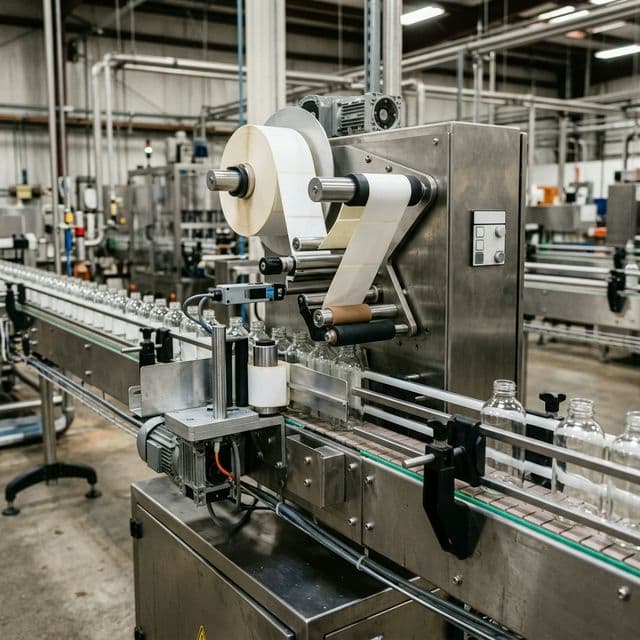
Industrial OPP Hot Melt Labeling Machine is frequently shortlisted for food and beverage packaging projects when buyers need 120-240 BPM output, 50-110 mm flexibility, and a machine platform already discussed for water bottle, juice bottle, and tea bottle. The industrial OPP hot melt labeler is built for high-volume bottled water and beverage lines that need wrap-around film labels at speed. This page narrows the fit question to how the machine performs inside food and beverage production requirements instead of treating it as a generic labeling machines option.
Food and Beverage filling projects usually start with water, juice, sauces, edible ingredients, and mixed liquid-food products, but the real machine choice depends on more than the product name. Buyers still need to understand container geometry, fill accuracy, cleaning routine, downstream cap style, and how often the line will switch between related SKUs. In practical factory work, those details decide whether the line stays stable after commissioning or becomes a constant adjustment project for the operators.
PakFill therefore evaluates food and beverage packaging by matching product behavior, bottle control, and line scope before discussing headline speed. Some projects need a compact filler with tighter dosing control. Others need stronger bottle guidance, better cap handling, or labeling support that keeps the retail finish consistent. Looking at the full process from filling through capping and labeling usually creates a more reliable recommendation than comparing one machine in isolation.
Commercially, this also helps buyers quote the right project scope from the beginning. When filling, capping, labeling, and control logic are reviewed together, the resulting proposal is easier to validate internally and easier to scale later. That is why factory-direct review often produces a better result for food and beverage buyers than a generic catalog comparison.
Because many buyers compare several suppliers at once, the most useful proposal does more than confirm that a machine can fill the product. It should explain why a specific filling principle, nozzle count, bottle-guiding arrangement, control stack, and downstream module set were chosen for the application. That explanation reduces risk during FAT, installation, operator training, and later product expansion. In practical terms, the best industry-focused solution is the one that keeps production stable after commissioning, shortens changeover when new SKUs are introduced, and gives the buyer enough process clarity to approve the project internally without guesswork. Buyers also benefit when the supplier can connect these technical decisions to maintenance access, spare-parts planning, and realistic commissioning workflow. For this combination, PakFill normally checks Sanitary machine design, Bottle-handling stability, and Hot-fill and cold-fill flexibility, confirms whether 304 Stainless Steel and anodized aluminum is appropriate for the formula family, and maps the machine scope against water, juice, sauce, and food. That keeps the quote discussion grounded in the real industry workflow rather than only the headline speed of the filler.
Before final quotation, buyers should still confirm the exact product behavior, container drawing, changeover plan, and the downstream capping or labeling scope. Industrial OPP Hot Melt Labeling Machine can be configured around the real bottle pace and operator workflow, but CIP expectations, bottle indexing, closure control, and inspection logic should always be reviewed against the practical needs of food and beverage production.