Optimization point
Matched filling principle
Heating Paste Filling Machine sits in the paste filling machines family and is usually selected when paste projects need equipment aligned with very high viscosity instead of a one-size-fits-all machine.
Loading…
Recevez une solution de remplissage conçue selon votre produit, votre contenant et votre cadence cible.
Paste Filling Machines
The heating paste filling machine is intended for high-viscosity or temperature-sensitive products such as honey, peanut butter, and wax. It is configured with Siemens PLC control, Festo pneumatics, Schneider electrical components, and industrial-grade contact materials for dependable production use.
Capacité de production
1,000-2,200 BPH
Têtes / Stations
2
Plage de remplissage
100-2,000 ml
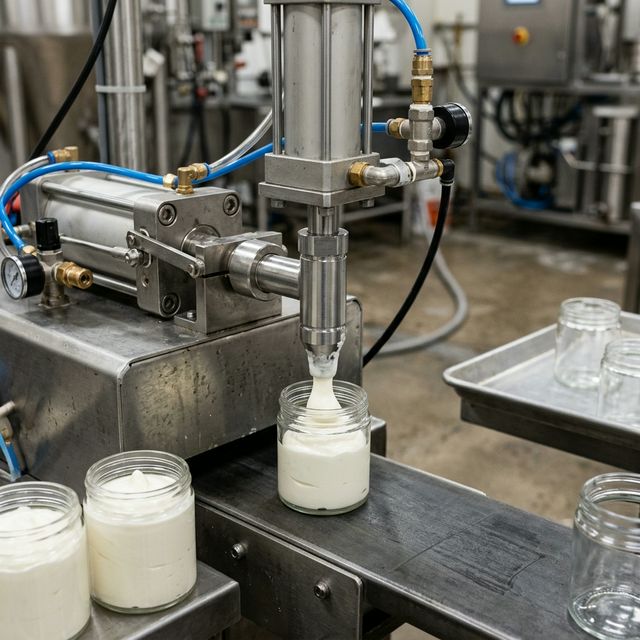
Paste Filling Machines configured for paste packaging with 1,000-2,200 BPH, 100-2,000 ml, and 316L Stainless Steel contact parts.
Métrique principale
1,000-2,200 BPH
Material
Paste
Fill Range
100-2,000 ml
Containers
Jar / Tub
Projet CTA
Indiquez votre format de contenant, votre cadence cible et le comportement produit. Nous vous orienterons vers la bonne configuration.
Material guide
Need a broader view first? Review the general Paste Filling Machine page before locking the final machine scope.
Project-fit overview
Heating Paste Filling Machine is a practical choice for paste filling when buyers need 1,000-2,200 BPH output, 100-2,000 ml flexibility, and a machine platform already selected for honey, peanut butter, and wax. The heating paste filling machine is intended for high-viscosity or temperature-sensitive products such as honey, peanut butter, and wax. This page narrows the discussion to how the machine behaves with paste, not just how it performs as a generic paste filling machines option.
Paste filling applies to products that are much thicker than ordinary sauces or liquids, including food pastes, waxes, gels, and other high-viscosity materials that may not flow consistently at room temperature. In these projects, a standard liquid filler usually cannot maintain stable dosing or clean shutdown. Paste fillers rely on piston, servo, or heated product handling to keep the fill weight repeatable and to reduce residue on the container mouth. Some products also need temperature support because they thicken during production. Pack style matters as well, since jars, tubs, and larger bottles each demand different nozzle travel and cutoff behavior. The right paste filling machine should therefore be selected around true product viscosity, fill temperature, target volume, and the desired cleanliness of the finished package. In this combination, the main engineering concern is usually very high viscosity. Paste products resist flow, so the filling system needs stronger dosing control and often slower, more deliberate product transfer. PakFill normally reviews Heated hopper and nozzles help maintain flow on dense products and Designed for thick products that need controlled transfer, 316L Stainless Steel compatibility, and the real bottle or jar geometry so the line can stay consistent across Jar, Tub, and Bottle. Some pastes become difficult to fill at ambient temperature, which makes heated hoppers or product paths necessary.
Before final quotation, buyers should still confirm the actual formula, fill volume, container drawing, and whether the project also needs capping, labeling, or washdown planning. Heating Paste Filling Machine can be configured around +/-0.5%, the real downstream pace, and the packaging style, but nozzle setup, anti-drip behavior, indexing, and cleaning logic should always be matched to the actual paste product instead of assumed from a broad machine category.
Optimization point
Heating Paste Filling Machine sits in the paste filling machines family and is usually selected when paste projects need equipment aligned with very high viscosity instead of a one-size-fits-all machine.
Optimization point
With 1,000-2,200 BPH throughput, 100-2,000 ml range, and +/-0.5% repeatability, the machine gives buyers a clearer starting point for balancing speed, giveaway, and container presentation.
Optimization point
PakFill normally checks 316L Stainless Steel, bottle handling, and downstream handoff so the machine fits Jar, Tub, and Bottle packs and future capping or labeling integration.
| Matériau du cadre | 304 Stainless Steel |
|---|---|
| Matériau de la pièce de contact | 316L Stainless Steel |
| Marque d'automate | Siemens |
| Marque pneumatique | Festo |
| Marque électrique | Schneider |
| Alimentation | 380V / 50Hz |
| Pression d’air | 0.5-0.7 MPa |
| Capacité de production | 1,000-2,200 BPH |
| Précision de remplissage | +/-0.5% |
| Têtes / Stations | 2 |
| Plage de remplissage | 100-2,000 ml |
| Principe de remplissage | Heated paste filling |
| Contrôle de la température | 30-90deg C |
| Contenant Compatible | jar, can, bottle |
| Consommation électrique | 3.4 |
| Dimensions (L x l x H) | 1,900x1,150x1,860 mm |
| Poids | 410 kg |
Process notes
Container focus
Plateforme d'automatisation industrielle pour le contrôle de cycles répétables.
Actionnement propre et composants pneumatiques réparables dans le monde entier.
Convient aux zones de contact avec des produits alimentaires, cosmétiques et chimiques.
Documentation et configuration de sécurité préparées pour les projets d'exportation.
Material handling priorities
Paste products resist flow, so the filling system needs stronger dosing control and often slower, more deliberate product transfer.
Some pastes become difficult to fill at ambient temperature, which makes heated hoppers or product paths necessary.
Dense products can smear the container mouth if the nozzle motion and shutoff are not matched to the product texture.
Produits Associés
This 2-head servo paste filler is designed for dense food and cosmetic products that need tighter volumetric control in a smaller footprint.
Capacité de production
1,200-2,400 BPH
Têtes / Stations
2
Plage de remplissage
50-1,500 ml
The vacuum cosmetic cream filler is configured for premium creams, gels, and ointment-style products packed into jars, tubes, and smaller bottles.
Capacité de production
1,000-2,000 BPH
Têtes / Stations
4
Plage de remplissage
30-300 ml
The 4-head servo piston filler targets medium-speed production of sauces, creams, gels, and honey-like products.
Capacité de production
1,800-3,600 BPH
Têtes / Stations
4
Plage de remplissage
100-1,000 ml
FAQ
Yes, this model is considered for paste projects when the real product behavior, fill volume, and package style fit the machine's range. PakFill still checks viscosity, foaming, temperature, and container control before confirming the final configuration.
The most useful inputs are the actual product sample or formula type, target fill volume, container drawing, output target, and whether the project also needs capping, labeling, or other downstream equipment.
The final answer depends on the exact container dimensions, but this page is usually relevant for Jar, Tub, Bottle, and Wide-mouth container. PakFill also checks whether the machine's 100-2,000 ml range and 1,000-2,200 BPH target remain realistic once the container changes.